
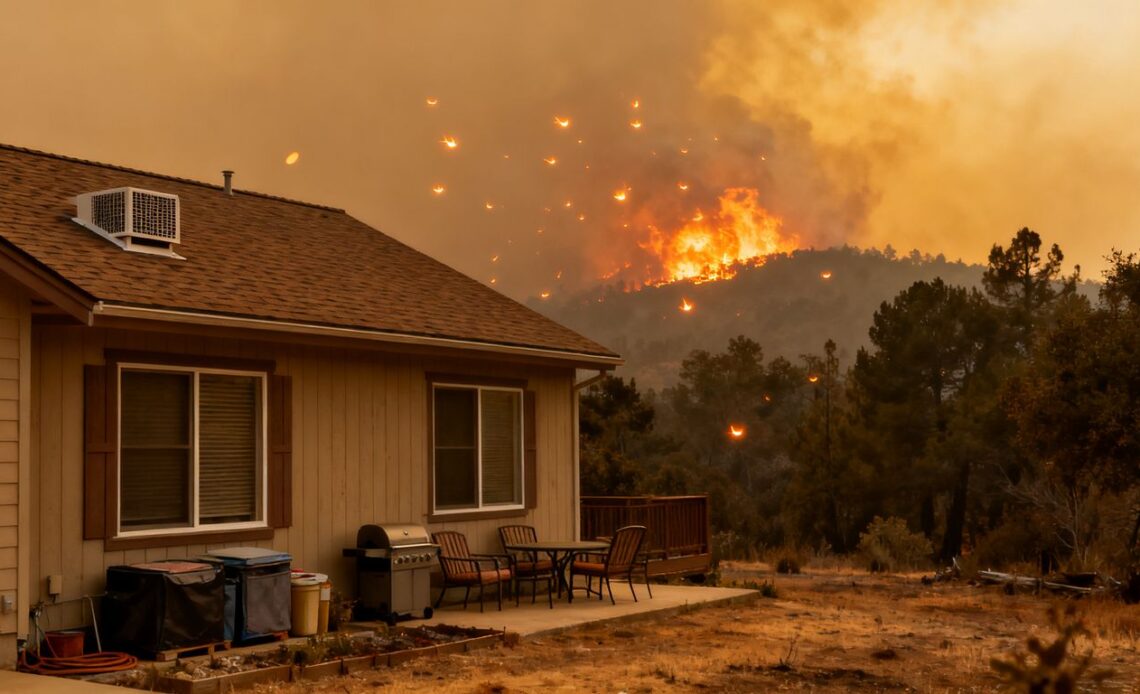
Wildfire damage does not always arrive as a visible wall of flame. Small burning fragments can move through the air, find dry fuel, and start a structure fire before residents see the main front. Understanding that sequence explains why small openings deserve serious attention when reducing ember intrusion home damage.
How wildfire embers travel ahead of the main fire
Embers form when vegetation, bark, roofing, or other combustible materials burn and break apart. Convective heat lifts these glowing fragments, while wind carries them across roads, yards, and developed areas. Some land quickly; others remain airborne long enough to reach structures well beyond the immediate fire edge.
Their movement is irregular rather than neatly predictable. A sudden gust can scatter embers into roof valleys, behind fences, or beneath outdoor furniture, where they may remain hot after the sky appears calmer.
Why ember intrusion can occur miles from the flame front
A home does not need to be next to flames to face an ignition threat. Wind can transport embers over substantial distances, and the fragments may enter a building through vents or settle into combustible material around the structure. That is why properties in apparently untouched neighborhoods can still ignite during a large wildfire.
Distance from the flame front may reduce radiant heat, but it does not eliminate airborne exposure. A property farther away can even receive embers while its occupants have little visual warning that the fire is approaching.
The role of wind, fire intensity, and local terrain
Wind affects both the direction and concentration of ember showers. Strong, shifting winds can carry burning material over ridges and into streets, while intense fires generate more embers from vegetation and structures. Hills, canyons, and gaps between buildings can channel airflow and produce uneven exposure from one property to the next.
Local conditions change quickly, so a calm period should not be treated as proof that the danger has passed. Fire weather alerts, official evacuation information, and local emergency instructions provide a more reliable basis for decisions.
How embers ignite homes through small vulnerabilities
An ember may ignite a home after landing on dry leaves in a gutter, pine needles in a roof valley, or mulch against siding. It can also pass through an opening and begin smoldering in an attic, crawl space, or enclosed deck. Once a small fire develops, heat and smoke can spread into materials that were never directly exposed to the original ember.
The most useful protection therefore combines material choices with housekeeping. The science of ember ignition offers a helpful explanation of why airborne embers, rather than direct flame alone, deserve attention during wildfire preparation.
The most common paths for ember intrusion
Homes contain many openings and horizontal surfaces that are ordinary parts of construction but potential ember collection points during a wildfire. Roof edges, vents, windows, decks, and utility penetrations all require different forms of attention. A careful review should consider both where embers enter and what combustible material is waiting nearby.
Roof coverings, valleys, and accumulated debris
Roofs are exposed to falling embers across their entire surface, but valleys, ridges, flashing, and roof-to-wall intersections can collect them. Leaves and needles increase the available fuel, particularly when they become trapped beneath tiles or along irregular edges. Even an otherwise sound roof can become vulnerable when debris is allowed to dry in place.
Regular removal of organic material is a simple measure with practical value. It should be paired with an inspection for cracked coverings, loose components, open joints, and gaps that could let embers reach the roof assembly.
Vents, eaves, soffits, and attic spaces
Vents connect outdoor air to enclosed areas, making them important ember pathways. Attic, crawl-space, foundation, and under-eave vents can admit burning particles when their screens are too open, damaged, or missing. Once inside, an ember may smolder unnoticed among insulation, dust, or stored items.
An ember-resistant vent guide describes smaller mesh openings and heat-resistant construction as ways to reduce the chance that embers and flames pass through these openings. The correct product and installation depend on the location, the building design, and applicable local requirements.
Windows, doors, and other openings
Glass can crack from heat, and gaps around window or door assemblies can provide a route for embers. Sliding doors, pet doors, mail slots, and poorly sealed garage doors deserve the same attention as more obvious openings. A closed opening is not necessarily a protected opening if its frame or surrounding weather seal is deteriorated.
The condition of the assembly matters as much as its label. Windows should be inspected for damaged seals, exposed combustible frames, and nearby fuels such as dry curtains, furniture, or stored boxes.
Decks, fences, mulch, and combustible attachments
Embers often ignite objects outside the home before the structure itself catches fire. Dry mulch, firewood, fences, patio cushions, and accumulated material beneath a deck can provide a sustained source of heat against siding or doors. Attached decks and stairs may also conceal debris in narrow, difficult-to-clean spaces.
Reducing these fuels interrupts the path from ember landing to structural ignition. Separation, regular cleaning, and thoughtful placement are especially important where a fence or deck connects directly to the house.
Gutters, chimneys, and exterior utility penetrations
Gutters can hold leaves and needles exactly where embers are likely to settle. Chimneys and flues require maintained spark protection, while gaps around pipes, cables, and electrical equipment can expose combustible framing or insulation. These details are easy to overlook because they are distributed around the exterior rather than concentrated in one visible feature.
A whole-home inspection should trace each penetration from the outside to the interior. Cleaning alone is not enough when a cover is loose, a seal has failed, or a component is not suited to the building’s wildfire exposure.
How to identify ember vulnerabilities around a home
A vulnerability assessment works best when it follows the path an ember might take from the sky to the structure. The inspection should include the roof, walls, openings, attached features, and the surrounding yard. Photographs and notes make it easier to track repairs rather than relying on memory.
Inspecting the roof and drainage systems
The roof inspection should look for debris, damaged coverings, open flashing, and places where vegetation touches or overhangs the roof. Gutters and downspouts should be checked for blockages, sagging sections, and combustible buildup. Roof areas hidden from ground view may require a qualified professional rather than an unsafe climb.
The goal is not simply to judge whether the roof looks new. It is to find collection points and conditions that could allow an ember to remain hot long enough to ignite nearby material.
Checking vents and enclosed areas for mesh protection
Every exterior vent should be identified and examined for intact screening, corrosion, gaps, and evidence of past pest damage. Enclosed decks, crawl spaces, eaves, and attic compartments should also be checked because an opening may be difficult to see from a normal standing position. Screens should not be assumed to provide ember protection merely because they are present.
The inspection should record dimensions, locations, and access constraints before replacement work begins. That information helps a contractor select compatible assemblies without blocking necessary ventilation.
Evaluating siding, windows, and exterior materials
Siding and trim should be assessed for cracks, exposed joints, peeling finishes, and contact with soil or vegetation. Windows and doors should be checked for frame condition, glass damage, and gaps around the perimeter. Particular attention belongs on corners, wall-to-roof intersections, and places where combustible materials meet one another.
A material that resists ignition can still be compromised by poor installation or nearby fuel. The assessment therefore needs to consider the complete assembly, not just the product name printed on a specification sheet.
Mapping combustible vegetation and stored items
A walk around the property can reveal dry shrubs beneath windows, branches above the roof, stacked lumber beside a wall, or cushions left near an opening. Mapping these items by distance from the structure helps separate urgent corrections from longer-term landscaping work. The same process should include sheds, play equipment, trash containers, and temporary construction materials.
A short field record can organize the review into practical categories:
- Roof and gutter debris
- Vents, openings, and damaged seals
- Vegetation and mulch near walls
- Deck, fence, and under-structure fuels
- Firewood, furniture, and stored flammables
After the walk, the household can assign each finding a repair date and responsible person. That turns a visual survey into a maintenance plan rather than a one-time exercise.
Assessing neighboring properties and shared exposure
Ember exposure does not stop at a property line. A neighboring fence, overgrown tree, woodpile, or attached structure can create heat and embers that reach the home. Shared driveways and narrow setbacks may also limit access for firefighters or make vegetation management more difficult.
Residents should discuss visible hazards respectfully and use local authorities or property managers when a concern cannot be resolved privately. The aim is a safer area around the home, not an isolated inspection that ignores surrounding fuels.
Home-hardening measures that reduce ember intrusion
Home hardening combines improvements to the structure with management of the immediate surroundings. No single upgrade makes a building invulnerable, and even ignition-resistant components require maintenance. The strongest approach closes several pathways at once while preserving the ventilation, drainage, and access the home needs.
Choosing ember-resistant vents and screening
Vents should be selected for their ability to resist ember entry while still performing their intended ventilation function. Screening must be securely attached, free of tears, and appropriate for the opening; a loose or poorly fitted cover can leave gaps around its edges. Crawl-space and foundation openings deserve attention alongside attic and eave vents.
The home hardening guidance places vent protection alongside roofing and defensible-space measures rather than treating it as a standalone fix. That broader approach is useful because an ember that cannot enter through a vent may still ignite debris outside the building.
Maintaining ignition-resistant roofs and gutters
An ignition-resistant roof is more effective when its joints, edges, valleys, and flashing are properly installed and kept clear. Gutters should be cleaned on a recurring schedule, especially after windy periods or leaf fall. Downspouts and roof drainage should remain functional so water does not create additional maintenance problems.
Residents should obtain advice suited to their roof type before replacing or modifying components. Fire performance depends on the covering, the assembly beneath it, installation details, and local construction rules.
Protecting windows, doors, and garage openings
Tempered or multi-pane glazing can improve resistance to wildfire heat, while tight-fitting doors and intact weather seals reduce opportunities for ember entry. Garage doors should close fully, and gaps around frames should be repaired with suitable materials. Pet doors, vents, and other small openings should be included in the same review.
Window coverings and outdoor shutters may offer additional protection when approved for the assembly and used correctly. They should not delay evacuation or encourage residents to remain outside during unsafe conditions.
Creating defensible space around the structure
Defensible space reduces the amount of combustible material available to carry fire toward the building. It includes pruning branches, spacing vegetation, removing dead plants, keeping grass managed, and separating woodpiles or other fuels from walls. The exact treatment varies with climate, slope, property size, and local guidance.
Landscaping should not be reduced to a bare ring around the home. A layered plan can preserve shade and habitat while limiting continuous fuels and maintaining access for emergency personnel.
Replacing or isolating combustible decks and attachments
Decks, stairs, trellises, and fences can transmit fire directly to the structure when they ignite. Replacing exposed components with more resistant materials may help, but the underside still needs to remain free of leaves and stored items. Where replacement is not immediate, separating a combustible attachment from the building can reduce direct contact.
A professional should evaluate connections, supports, and drainage before alterations are made. Cosmetic changes alone will not resolve a hidden fuel pocket beneath a deck or at a wall junction.
How building materials affect wildfire resilience
Materials influence how quickly a home ignites, but their performance depends on the full construction system. A fire-resistant covering can be undermined by debris, gaps, or combustible details at its edges. Product selection should therefore be paired with sound installation and an understanding of the home’s specific exposure.
Comparing roofing materials and installation details
Classified fire-resistant roofing materials may include metal, asphalt composition products, tile, slate, and other assemblies approved for the location. Their protection depends on the covering, underlayment, vents, flashing, and roof geometry. Valleys and roof-to-wall transitions deserve particular care because they can collect embers even when the field of the roof is intact.
A contractor can explain how a proposed assembly performs under local codes and whether the existing structure can support it. The least expensive covering is not necessarily the least expensive choice once installation and maintenance are considered.
Selecting siding and trim for wildfire-prone areas
Noncombustible or ignition-resistant siding can reduce vulnerability, particularly when joints and penetrations are well sealed. Trim, soffits, fascia, and corner details also matter because fire can begin at a small exposed edge. Materials should be kept clear of soil, mulch, and dense vegetation.
Siding selection should account for climate and repair needs as well as fire performance. A durable material that is correctly installed and regularly maintained generally offers more dependable protection than a nominally resistant product with open gaps.
Using tempered glass and fire-resistant window assemblies
Tempered glass is less likely to fail under heat than ordinary glass, although no window should be treated as an absolute barrier. Multi-pane assemblies, protected frames, and well-maintained seals can improve the overall performance of an opening. Nearby combustible curtains, furniture, and vegetation remain relevant even when the glazing is upgraded.
Window replacements should be evaluated as assemblies rather than by glass type alone. Frame material, installation, shutters or coverings, and the surrounding wall construction all influence how heat and embers affect the opening.
Understanding the limits of ignition-resistant materials
Ignition-resistant does not mean fireproof. Materials can still be exposed to sustained heat, direct flame, mechanical damage, or an accumulation of burning debris that exceeds their intended conditions. Weak points at seams, corners, vents, and attachments may determine the outcome.
That limitation argues for layered protection. A resistant roof, screened vent, clear gutter, and managed yard work together more effectively than any one upgrade considered in isolation.
Balancing performance, cost, and local building requirements
Wildfire upgrades should be prioritized according to exposure and likely benefit. A household may begin with cleaning and sealing, then address vents, roof repairs, windows, landscaping, or attached structures as resources allow. Local building departments, fire agencies, and qualified contractors can clarify permitted materials and required installation methods.
Insurance questions should be raised before major work begins. Documentation of approved improvements may be useful, but coverage decisions belong to the insurer and vary by policy and location.
How to prepare a home before wildfire season
Preparation is most effective when it happens before smoke is visible and contractors are busy across an entire region. Seasonal work should combine inspection, cleaning, vegetation management, and emergency planning. A written schedule reduces the chance that small maintenance tasks will be forgotten.
Creating an ember intrusion inspection checklist
A checklist should cover the roof, gutters, vents, eaves, windows, doors, garage, decks, fences, landscaping, and stored materials. Each item can be marked as clear, damaged, combustible, or requiring professional review. Photographs and dates provide a useful record for recurring inspections.
The checklist should also include the property’s boundaries and nearby exposure. Reviewing the same points each year makes gradual deterioration easier to spot.
Cleaning roofs, gutters, vents, and enclosed spaces
Leaves, needles, and dust should be removed from roof valleys, gutters, downspouts, vent openings, and beneath decks. Enclosed spaces should be checked for nests, cobwebs, and stored combustible materials. Cleaning should be performed safely, with appropriate fall protection and attention to electrical hazards.
The timing matters. A clean roof can collect new debris after one windy day, so inspections should be repeated during periods of elevated fire weather rather than completed only once in spring.
Managing vegetation and combustible debris
Dead branches, dry grass, fallen leaves, and excess mulch should be removed or managed according to local guidance. Trees should be pruned so branches do not overhang the roof, while shrubs should be arranged to avoid continuous fuel from the ground to the structure. Green appearance alone does not guarantee low combustibility during extreme heat.
The wildfire preparation guidance for Texas homes illustrates how risk assessment, landscaping, construction choices, and evacuation planning fit together. Residents in other regions should use their own fire agency’s recommendations for local vegetation and weather conditions.
Securing outdoor furniture, firewood, and fuel sources
Outdoor furniture, cushions, umbrellas, trash containers, and lightweight decorations can become burning projectiles or collect embers. They should be moved away from the structure when conditions worsen, while firewood, propane cylinders, gasoline, and other fuels should be stored in approved locations. Sheds and detached garages also need inspection because they can become secondary ignition sources.
These measures should be planned in advance rather than improvised during an evacuation warning. Clear instructions help every household member act quickly and consistently.
Planning maintenance for recurring wildfire risk
Wildfire preparation is ongoing because roofs age, screens corrode, vegetation grows, and neighboring conditions change. A seasonal calendar can assign dates for gutter cleaning, pruning, vent checks, roof inspections, and replacement of damaged seals. Property owners should retain receipts, photographs, permits, and contractor records where appropriate.
Recurring maintenance also provides an opportunity to reconsider priorities after each fire season. A near miss, a new development nearby, or a change in household needs may justify a fresh risk assessment.
What to do during and after an ember-producing wildfire
During an active wildfire, personal safety takes priority over property protection. Residents should rely on official emergency communications and leave when directed, even if the home appears unaffected. After the event, ember damage may be hidden, delayed, or present in areas that are unsafe to enter without professional support.
Monitoring conditions and following evacuation orders
Residents should monitor local emergency alerts, fire agency instructions, evacuation maps, and utility notices. An evacuation order should be followed promptly, with attention to routes that may change because of smoke, closures, or shifting fire behavior. Household members, pets, medications, documents, and essential equipment should be accounted for before departure.
A home-hardening project never justifies remaining in a threatened area. Structural improvements are intended to reduce risk over time, not to replace evacuation planning.
Limiting exposure to airborne embers when safe to do so
If officials have not ordered evacuation and conditions permit brief exterior work, residents may close windows and doors, move combustible outdoor items, and remove small amounts of debris from accessible areas. Protective clothing, eye protection, gloves, and respiratory precautions may be appropriate, but smoke and wind can make outdoor activity dangerous very quickly.
People should never work outside when flames, intense heat, poor visibility, or emergency instructions indicate that it is unsafe. Leaving early is safer than attempting last-minute ember defense.
Inspecting for hidden smoldering ignition points
After the immediate threat has passed and authorities allow reentry, residents should inspect gutters, roof valleys, vents, decks, fences, mulch, attics, crawl spaces, and wall edges for smoke, heat, or smoldering material. A fire may continue inside an enclosed space after the visible ember has gone dark. Odors, warm surfaces, discoloration, and faint smoke all warrant caution.
Water should not be applied indiscriminately around electrical systems or unstable structures. Fire officials or qualified professionals can help locate concealed ignition and determine whether the building is safe to occupy.
Documenting ember intrusion home damage for insurance
Photographs and video should capture damage before cleanup whenever it is safe, including soot, burned debris, melted screens, damaged roofing, broken windows, and affected landscaping. A written inventory can connect each damaged item with receipts, serial numbers, or prior photographs. Residents should report the loss promptly and keep notes from conversations with the insurer.
Documentation should distinguish emergency mitigation from permanent repairs. The policy, insurer, and local authorities determine what evidence and approvals are required.
Prioritizing professional assessment and safe repairs
A qualified inspector, roofer, electrician, chimney professional, or structural contractor may be needed depending on the suspected damage. Professionals can assess hidden heat damage, compromised framing, ventilation, wiring, and water intrusion that are not obvious during a casual walk-through. Temporary repairs should not conceal evidence or create new hazards.
Only after the structure is declared safe should permanent work proceed. The lessons from practical ember protection measures can help frame future improvements, but site-specific advice remains essential after an actual fire.