
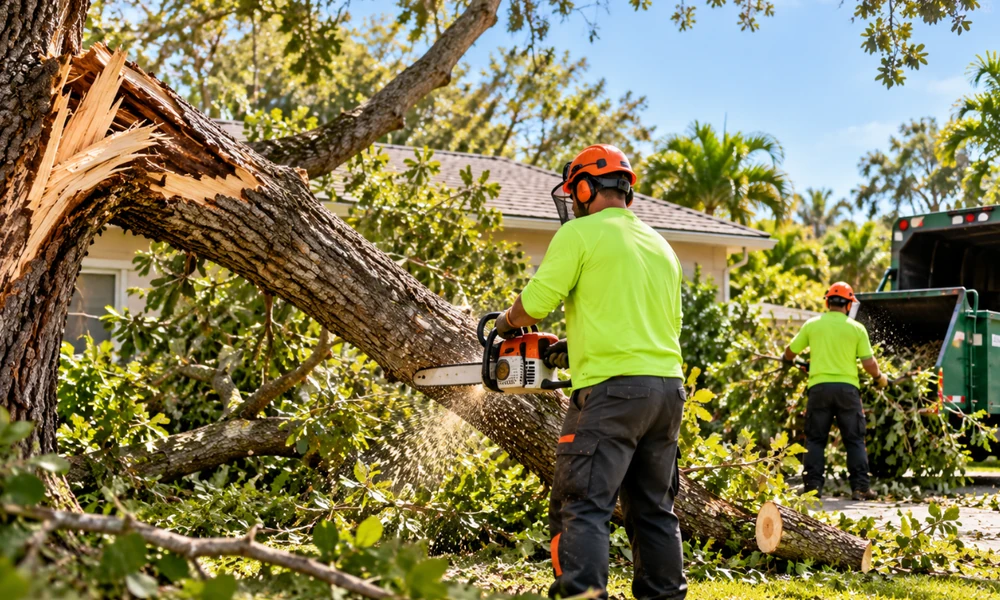
Storms can leave trees looking very different in just a few minutes.
Branches may break. Limbs can hang over roofs or driveways. A tree may suddenly lean, or the canopy may look uneven after strong wind. Sometimes the damage is obvious. Other times, the tree still looks mostly normal even though parts of it may need closer attention.
That is why storm-damaged trees often need to be looked at carefully before deciding what to do next.
Arbor Wise Tree Services provides tree restoration services for trees affected by storms and other types of stress. The company also handles tree removal when conditions make removal the more appropriate option.
Does Storm Damage Always Mean a Tree Needs to Be Removed?
Not necessarily.
A damaged tree may still have healthy sections and a stable structure. In other cases, damage may be serious enough that removal needs to be considered.
The important part is understanding the condition of the individual tree.
Broken branches are only one piece of the picture. The trunk, major limbs, root area, overall balance, and position of the tree can all matter when deciding what should happen next.
That is why one damaged tree may be a candidate for restoration while another may require a different approach.
What Does Tree Restoration Involve?
Tree restoration focuses on helping a damaged or stressed tree recover when that remains a reasonable option.
The exact work can depend on what happened to the tree.
Storms may leave broken branches, damaged portions of the canopy, or areas that need pruning. A tree may also have existing disease, pest problems, or environmental stress that becomes more noticeable after severe weather.
Restoration may involve addressing damaged growth and helping improve the tree’s overall condition over time.
Still, restoration is not a guarantee that every damaged tree can be saved.
Why Should Broken Limbs Be Looked At Carefully?
A broken branch can sometimes be more complicated than it appears from the ground.
A limb may still be partly attached. Another branch may have been damaged where it connects to the trunk. The canopy may also have lost enough weight on one side to change the way the tree looks and grows.
Simply cutting off whatever appears broken may not always provide the full answer.
Careful pruning can help remove damaged material while taking the remaining structure into account.
When Might Tree Removal Be Considered?
Removal may come into the conversation when a tree has serious storm damage or other concerns involving its condition and location.
Arbor Wise Tree Services’ tree-removal work includes situations involving storm damage, disease, safety concerns, and construction.
The decision should still be based on the actual tree.
For example, a heavily damaged tree near a building may raise different concerns than a tree with lighter canopy damage in an open part of a yard.
There is no single storm-damage rule that applies to every tree.
Why Does the Tree’s Location Matter?
A tree does not exist by itself.
Nearby homes, fences, vehicles, sidewalks, utility areas, and landscaping can affect how damage is evaluated.
A damaged branch over an empty section of yard is a different situation from a similar branch hanging over an entrance.
That does not automatically make one tree dangerous or the other safe. It simply shows why location is part of the overall assessment.
Looking Beyond the Immediate Damage
After a storm, it is natural to focus on the biggest broken branch or the most visible damage.
But the entire tree matters.
Arbor Wise Tree Services works with both tree restoration and tree removal, allowing storm-damaged trees to be considered based on their condition rather than assuming that every damaged tree needs the same solution.
For property owners, the main goal is to understand what happened to the tree, what parts may need attention, and whether restoration, pruning, removal, or continued monitoring makes the most sense for the situation.