

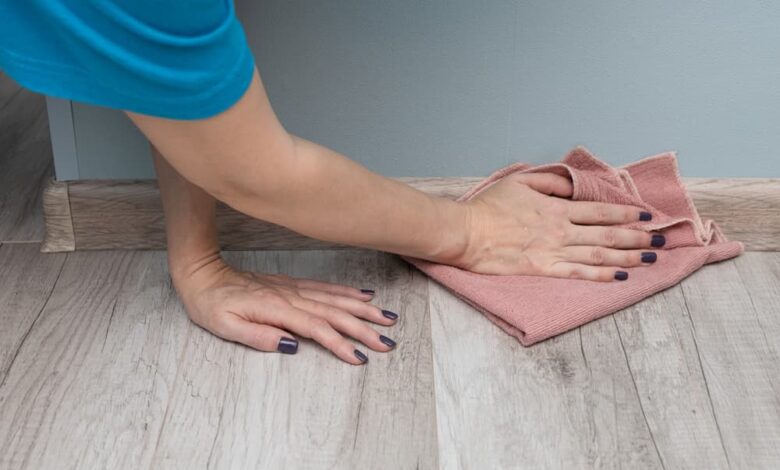
You’ve hoovered, mopped, plumped every cushion, and lit a candle that cost more than your last takeaway. Then, you glance down and realise your skirting boards are wearing a visible stripe of dust like a bad highlight job.
Don’t worry, though. With the right technique, you can get them looking sharp without spending your whole Saturday crouched along the walls. Let’s dive in.
Grab Your Supplies
Before anything else, round up what you need, so you don’t interrupt yourself every five minutes to hunt down a cloth.
You want a vacuum with a soft brush attachment, a couple of microfibre cloths, a bucket of warm water, washing-up liquid, an old toothbrush for tight corners, and a dry towel.
If you’ve got hard floors and no knee pad, go grab a cushion. You’ll be working at floor level, and your knees will absolutely let you know about it if you ignore them.
For wooden skirting boards, check that whatever cleaner you’re using is wood-safe, rather than just grabbing the nearest spray bottle.
And if your boards have a delicate finish like chalk or matte paint, do a quick test on a hidden bit of wall before you go all in. Some finishes are more high-maintenance than they look, and discovering that mid-clean is nobody’s idea of fun.
Remove Dust and Loose Debris
It’s tempting to go straight in with a wet cloth, but damp dust turns into a smeared grey paste, so you’ll just end up making more work for yourself.
Instead, use your vacuum’s brush attachment and run it slowly along the top edge and the face of the boards.
No brush attachment? A soft brush or even a dry microfibre cloth will work, but shake it out regularly so you don’t redistribute the dust you’ve just removed.
Give the top ledge a bit of extra attention. That narrow strip tends to collect more dust than you expect because it’s rarely touched.
If you have pets, you’ll often find fur gathering there too, especially near doorways and radiators where air tends to circulate.
Tackle Grime with the Right Cleaner
Now that the dust is out of the way, you can deal with the slightly sticky layer that seems to appear out of nowhere.
Skirting boards in hallways and kitchens tend to collect faint smudges from general day-to-day traffic. Here’s how to clean them step-by-step:
- Fill a bucket with warm water and add a small amount of washing-up liquid. Keep it light. You want to add enough to cut through grease but not so much that you’re left with a soapy film afterwards.
- Dip your cloth in and wring it out well. It should feel damp, not dripping. If water is running down the wall, it’s too wet.
- Clean in manageable sections, around a metre at a time. Wipe from top to bottom so any light drips are picked up as you move down. Also, rinse your cloth often and change the water if it starts looking cloudy.
- If you’re working on wooden skirting boards, be especially careful with moisture. Wipe gently in the direction of the grain with your wood-safe cleaner, then dry the area quickly with a clean cloth to protect the finish.
Don’t Forget the Corners and Edges
Most people call it done at this point. From standing height, everything may seem fine. But if you glance down at the corners, you’ll probably find some grime hiding there. The junction where two walls meet and the groove along the floor are basically dust traps by design.
So, get your toothbrush in there and work it gently into those tight spots. For really stubborn build-up in the seams, wrapping a cloth around the end of a butter knife will give you something firm enough to push in without scratching the paint.
If there’s furniture against the wall, shuffle it forward a few centimetres to give yourself enough space to clean the sections that haven’t been touched in months.
Deal with Scuffs and Marks
After cleaning the corners and edges, take a step back and look at the boards as a whole. Any scuffs will be much easier to spot now.
They often appear near door frames, staircases, and busy hallways where shoes and bags constantly brush past.
To get rid of them, use a damp microfibre cloth and apply steady, controlled pressure to the mark. Often, that’s enough to lift lighter scuffs caused by rubber soles.
If the mark is more stubborn, mix a small amount of baking soda with water to form a mild paste, apply it with your cloth, and rub carefully over the area.
A melamine sponge can help with tougher marks, but treat it as a last resort. It works through very fine abrasion, which means that if you use it repeatedly in the same spot, it can gradually wear down the paint.
Dry and Buff for a Polished Finish
You’re almost done, but this is the step that makes the difference between ‘clean’ and ‘properly polished.’
Don’t leave the boards to air-dry on their own. As the water evaporates, it can leave faint marks behind, especially on darker paint.
Instead, grab a clean, dry cloth and wipe each section well to lift any leftover detergent and prevent streaks from forming.
If you’re working with wooden boards, drying them quickly will also stop moisture from seeping into the joints or edges.
And if you want to go a step further, give painted boards a light final buff with a dry microfibre cloth. It’ll even out the surface and restore that soft, subtle sheen.
Set a Maintenance Routine That Sticks
Well done—your skirting boards are spotless now. So, let’s keep them that way without turning this into a regular deep-cleaning project.
The next time you hoover your floors, just run the brush attachment along the skirting at the same time. It’ll take just an extra minute, but it’ll stop that heavy dust layer from forming in the first place.
Then, every couple of months, use a damp cloth after you vacuum to catch anything that’s started to settle in.
However, if keeping on top of it yourself feels unrealistic, you can always hire a cleaner for some extra help. Just make sure skirting boards are on the brief from the start.
Conclusion
Your walls deserve better than that dusty outline hugging the floor like it’s part of the décor. So, give those baseboards a quick once-over every now and then.
That way, you’ll never be stuck shuffling along the wall for hours like you’re training for an endurance sport. And you’ll get to enjoy that rare, underrated feeling of a home that looks spotless.

